In a world ruled by rules—gravity, evolution, survival of the fittest—some organisms break them and survive anyway. They’re outliers. Biological rebels. Creatures that by all logic shouldn’t exist… yet they do.
Nature is full of weirdos, but some lifeforms are so strange they seem like sci-fi leftovers. Immortal, limb-regrowing, radiation-immune, even vacuum-surviving—these species force scientists to rethink what life is actually capable of.
Here are some of the world’s strangest organisms—and the science that makes them not just real, but impossible to ignore.
The Immortal Jellyfish (Turritopsis dohrnii)
Immortality sounds like myth. But there’s a jellyfish that can do it.
Native to oceans worldwide, Turritopsis dohrnii doesn’t die of old age. Instead, when it’s injured, starving, or aging, it triggers a process called transdifferentiation—turning its adult cells back into juvenile ones. In simple terms, it reverts its age. Again and again. Potentially forever.
This loop isn’t true immortality—it can still be killed by predators or disease—but biologically, it has no programmed end. Researchers are studying its cellular mechanisms to understand regeneration and aging in humans.
The Axolotl (Ambystoma mexicanum)
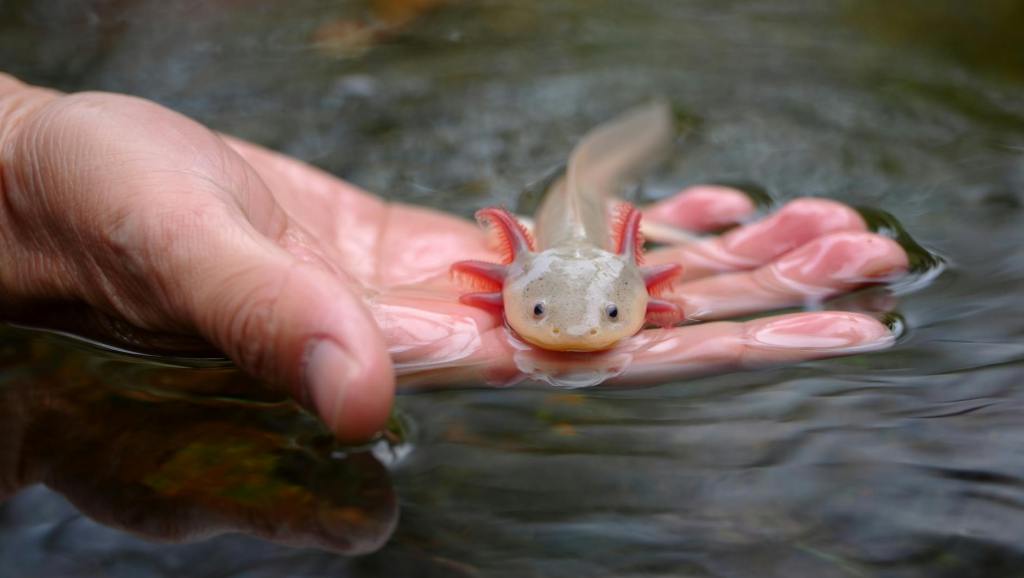
Known for its permanent smile and frilly head gills, the axolotl is a Mexican amphibian that never really grows up—it stays in its juvenile, aquatic form its whole life, a condition called neoteny.
But what makes the axolotl truly bizarre is its regeneration. It can fully regrow entire limbs, parts of its brain, spinal cord, heart tissue, and even parts of its eyes—without scar tissue.
Most animals can’t do this. Even other salamanders have limits. Scientists are using axolotls to study how cells regrow without mutating into cancer, hoping to one day apply that knowledge to human healing.
The Tardigrade (Water Bear)
Tardigrades are microscopic, eight-legged creatures that live in water films on moss and soil. They’re nearly indestructible.
They’ve survived:
- Extreme heat and cold (from near absolute zero to above boiling)
- High radiation
- Intense pressure
- Complete dehydration for decades
- Exposure to space and vacuum conditions
How? Tardigrades enter a state called cryptobiosis, where they dry up, stop metabolic activity, and become almost lifeless—like a paused game. In this state, they’re protected by proteins and sugar molecules that shield their DNA from damage.
They’re proof that life can survive beyond Earth-like conditions—and possibly on other planets.
The Platypus (Ornithorhynchus anatinus)
It lays eggs. It has fur. It produces milk. It has a duck bill. It’s venomous. It’s a mammal. None of that should go together.
When British scientists first examined a platypus in the 1800s, they thought it was a fake—a stitched-together prank. But it wasn’t. The platypus is one of only five surviving species of monotremes, mammals that lay eggs.
Males also have venomous spurs on their hind legs, delivering a painful chemical cocktail. And their bill? It’s not just for looks. It’s loaded with electroreceptors that detect tiny signals from prey in muddy water.
The platypus breaks every rule in the mammal playbook—and reminds us that evolution doesn’t care about fitting in.
The Glass Frog (Hyalinobatrachium fleischmanni)
Native to Central and South America, the glass frog has see-through skin on its underside. You can literally see its beating heart, organs, and digestive system.
While the transparency might seem like camouflage, scientists believe it’s also useful for thermal regulation and reducing shadows that predators might notice.
Recent studies found that glass frogs have the ability to hide their red blood cells in their liver while they sleep, reducing visibility through their skin and avoiding detection by predators. That’s an unheard-of biological strategy in vertebrates.
The Green-Blooded Lizard (Prasinohaema)
Found in New Guinea, this bright green lizard isn’t colored by skin pigment—it has green blood.
Its blood contains extremely high levels of biliverdin, a toxic byproduct of red blood cell breakdown. In most animals, even small amounts of biliverdin cause jaundice and liver damage. But for this lizard, it’s totally normal.
Scientists are baffled by how it avoids poisoning itself. Some believe the high biliverdin concentration may help protect against parasites or infections, acting as a kind of internal defense.
It’s a biological contradiction—and a mystery still being unraveled.
The Naked Mole-Rat (Heterocephalus glaber)
It’s blind, wrinkled, nearly hairless, and lives underground. But don’t underestimate it.
Naked mole-rats resist cancer, feel almost no pain, and can survive in low-oxygen environments that would kill humans in minutes. They also live ten times longer than other rodents their size, with little age-related decline.
Their cells are weird. Their DNA repair systems are unusually efficient. Their brains can switch to fructose metabolism when oxygen runs low, something only plants typically do.
They’re a biomedical goldmine—and a glimpse into what extreme survival really looks like.
Final Thoughts
We often assume evolution follows a neat, logical path. But nature is experimental. Life isn’t a checklist—it’s a playground. These creatures didn’t just adapt. They rewrote the rules.
From regenerating limbs to surviving in space, these organisms challenge our assumptions about biology, aging, and survival. They’re not just bizarre animals—they’re reminders that life is far stranger, more flexible, and more creative than we give it credit for.
And if Earth can produce life this weird, imagine what’s possible beyond it.
 The Zuara Press
Leave a comment