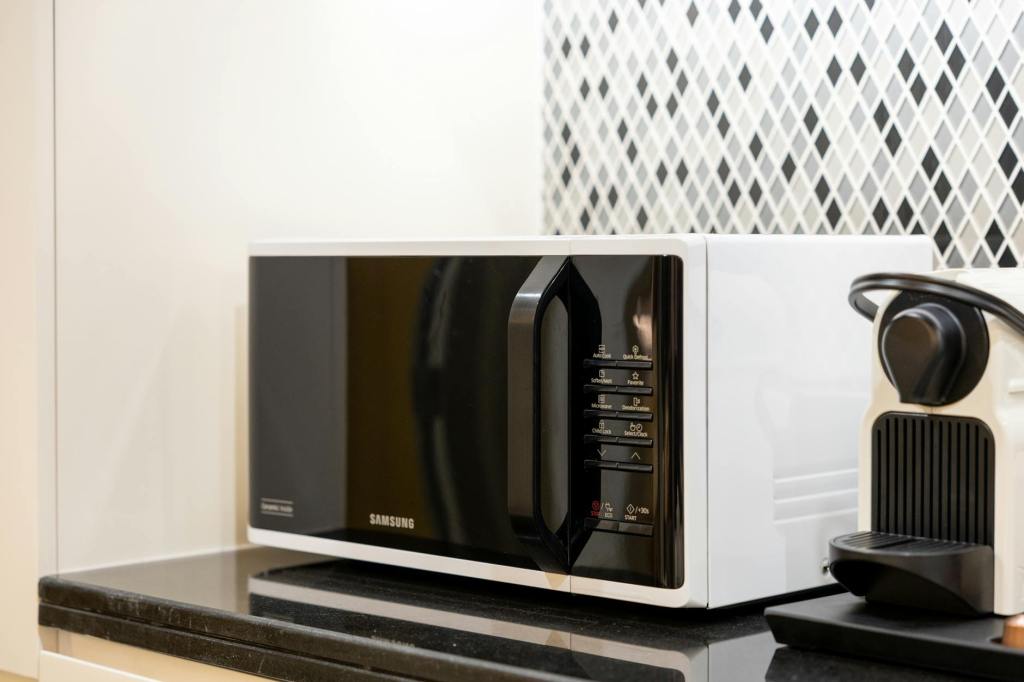
Every time you reheat leftovers, pop popcorn, or defrost a frozen meal, you’re using one of the most powerful examples of applied physics in everyday life. The microwave oven is not just a kitchen gadget—it’s a controlled electromagnetic reactor designed to agitate molecules until they generate heat.
But what actually happens inside that humming box? Why don’t microwaves cook food from the outside in, like an oven? And what exactly are these “waves” that heat your dinner in seconds?
Here’s a full breakdown of the real science behind how microwaves cook your food—and why it works so well.
Microwaves Use Electromagnetic Waves—Not Heat
Despite the name, a microwave oven doesn’t heat food by blowing hot air around. It works by sending out high-frequency electromagnetic waves—specifically, microwaves with a frequency of about 2.45 gigahertz. That’s close to the same frequency as some Wi-Fi signals, but much more intense and focused.
These waves are part of the electromagnetic spectrum, sitting between radio waves and infrared. They’re invisible, fast, and extremely good at one thing: making polar molecules, like water, vibrate.
Inside the microwave oven, a device called a magnetron converts electrical energy into microwaves. These waves bounce around the metal walls of the oven until they hit your food.
Water Molecules: The Real Target
Most of the food you eat contains water, even if it doesn’t look wet. Water molecules are polar, meaning they have a slight positive charge on one side and a slight negative charge on the other. When a microwave field passes through them, these charges try to line up with the rapidly flipping electric field.
Since microwaves oscillate 2.45 billion times per second, water molecules begin rotating back and forth just as fast. This rapid rotation causes friction between molecules, which creates heat. That heat then spreads through the food by conduction.
It’s not just water that responds—fats and sugars can absorb microwave energy too—but water is by far the most efficient absorber. That’s why drier foods don’t heat as well and why things like soup or pizza heat unevenly depending on moisture content.
Why Microwaves Cook from the Inside Out (Kind Of)
Microwaves penetrate into food to a depth of about one to two inches, depending on density and water content. That means they don’t just heat the surface like a regular oven—they heat within the outer layers. That’s why some foods can feel cool on the outside but burn your tongue on the first bite.
However, it’s a myth that microwaves cook entirely from the inside out. They penetrate deeper than radiant heat, but not all the way through large items. In thicker foods, the inside still cooks by conduction—heat moving from the warmer outer layers inward.
Standing Waves and Turntables
If microwaves bounced randomly, they’d leave hot and cold spots. In fact, this used to happen in early models. Engineers discovered that the waves inside the oven form standing waves—specific patterns where some areas get lots of energy and others get very little.
That’s why modern microwaves use turntables or rotating antennae. By constantly moving the food or the waves, you average out those energy differences to get more even heating.
Ever noticed that your pizza pocket is molten lava in one bite and frozen in the next? That’s still due to irregular distribution of water and density in the food itself.
What About Metal?
Putting metal in a microwave is famously dangerous—but it depends on the metal’s shape. Flat, smooth metal like the walls of the oven are safe and reflect microwaves. Crinkled foil or forks, however, can create concentrated electric fields at sharp edges or points. This causes electrons to arc through the air, which can ignite sparks or fires.
That’s why your microwave has a metal mesh screen on the window—it’s designed to reflect microwaves but still let you see inside, using holes smaller than the wavelength of the radiation.
The Power and Limits of Microwave Cooking
Microwaves are fast because they deliver energy directly to water molecules. They’re incredibly efficient for reheating, steaming, or cooking soft foods. But they don’t brown or crisp well, because they don’t reach high enough temperatures to cause the Maillard reaction—the chemical process that gives grilled meat or baked bread its flavor and texture.
That’s why microwave food often looks pale and soggy. Modern microwave-oven hybrids or “crisper” trays aim to fix that by adding infrared or convection elements.
Microwaves also can’t penetrate evenly through very thick or dense items. That’s why instructions tell you to stir halfway or let food “stand” after heating. That standing time allows heat to redistribute through conduction.
Final Thoughts
The microwave oven is a perfect example of how physics became kitchen magic. It takes invisible waves, targets water molecules, and uses the basic laws of electromagnetism to deliver fast, efficient heat.
What makes it so extraordinary isn’t just that it works—it’s how precisely it uses science to do something that would otherwise take ten times as long.
So next time your frozen burrito starts to steam after a minute, remember: you’re not just heating food. You’re watching applied quantum electrodynamics at work.
 The Zuara Press